November 9, 2009

Fernandina Beach House Investigation

Fernandina Beach is on Amelia Island, the southernmost of the Sea Islands and at the northernmost point of Florida’s Atlantic coast.  Once a bustling 19th century port, today it’s a quaint town with small shops and Victorian-era houses. Just north of Fernandina Beach lies Old Town, the town’s original site before it was moved in 1853. It was here a few of my classmates and I spent a February day investigating the age of an old house slated for demolition.

Old Town was platted in 1811 according to the Law of the Indies, an urban plan favored by Spain for all its colonial towns. According to a windshield survey in the 1980s, this house may have dated to the island’s Spanish rule, which ended in 1821. Thus, it was referred to as “The Oldest House in Fernandina.” A man bought the property in 2002 for $150,000 and planned to raze the dilapidated house to build a new one. In 2005, the house was found to be the former home of key figures in the black community in the early 1900s, and there were cries to restore for use as a Gullah history museum. The owner was patient and agreed to give time some for a funding source to be found to move the house.

But all the talk to preserve the house was just that — talk. After a few years, the demolition permit was issued and the University of Florida was allowed to come in and determine once and for all if 801 Somerulus was as old as advertised.

Here’s a news article.

Fernandina 003

Isn't it great looking? To be fair, it had not be occupied since at least the mid-1980s.

Fernandina 010

The house was situated on Plaza San Marcos, the square the town was platted around.

The house was situated on the Plaza San Marcos, the open land the town was formed around in 1811. Its location was one of the reasons it was believed to have been so old. However, the house was situated facing away from the plaza, indicating a later construction date.

map

Here's the orginal map with a yellow dot showing where the house was located. Photo courtesy of www.oldtownfernandina.org.

046

The corner posts had mortise and tenon joints.

Fernandina 040

The blocks of wood holding the house up were squared by hand.

045

More timber framing with carpenter's marks were found in the trusses.

Fernandina 062

The fireplace bricks were kilned by hand and held together with lime mortar. Notice the bead board to the right.

Fernandina 030

Machine-cut lumber and cut nails.

To sum up, the house was believed to be from the early 1800s because:

  • it was located along the plaza;
  • hand-sawn wood blocks were found its foundation;
  • it had mortise and tenon posts;
  • it had mortise and tenon framing in the attic;
  • and it had a hand-kilned bricks in its fireplace held together with lime mortar.

It may not have been the oldest because:

  • it was situated facing away from the plaza, not toward it;
  • the foundation blocks could’ve been reused;
  • the mortise and tenon posts could’ve been reused;
  • the mortise and tenon rafters weren’t in the order of their numbers, indicating they had been reused;
  • the bricks could’ve been reused;
  • the house had some balloon framing, a post Civil War construction technique;
  • it was full of cut nails, another post Civil War development;
  • and most of it consisted of 20th century construction materials such as beadboard.

But the clincher for it being a later construction date was when we found out a powerful hurricane in 1898 did a lot of damage in Fernandina and leveled many houses. Fernandina being on an island, the residents no doubt would have reused materials when rebuilding. Armed with this knowledge, we were confident that while the house  had parts that could’ve dated to the Spanish period, it was probably built around 1900.

Bonus: When putting this entry together, I found photos of the house being deconstructed. It’s good to know that despite the house’s awful condition, a lot of the materials were salvaged.

fernandina 5

Courtesy of SJ Mowery.

fernandina 4

Who knew there was such an amazing frame underneath? Courtesy of SJ Mowery.

fernandina 2

Going. Courtesy of SJ Mowery.

fernandina 3

Going. Courtesy of SJ Mowery.

fernandina 1

Gone. Courtesy of SJ Mowery.


October 26, 2009

“Flag Wars”

FlagWarsLogo

Watching a movie at 9:30 on a Monday morning isn’t something I would choose to do, but that’s what we did in my Urban Planning History and Theory class last week — and I’m glad we did.

The movie was “Flag Wars,” a documentary about Olde Towne East in Columbus, Ohio, a predominately black neighborhood undergoing gentrification. I heard the theory before that same-sex couples are often gentrification crusaders, the reason being they usually don’t have children whose safety and schooling they have to worry about. Also, with two incomes they’re likely to have the extra money required for renovations. That was the case in Olde Towne East, which had originally been home to some of Columbus’ most prominent residents. Once the gay community started moving in and rehabilitating the grand old homes, historic district code enforcement began cracking down on the poorer residents. A tension arose between the blacks and gays. The black people had lived in the neighborhood for years and while they knew it had problems, it was their home and they didn’t like another traditionally oppressed group nudging them out. The gay people saw excellent architecture in disrepair and wanted to bring it back to its original splendor. In turn, they wanted a community of like-minded people to call home, even if it meant forcing out the black people.

Gentrification gets a bad rap, but it has some positives — historic homes get restored, it brings a more stable population, crime shrinks, and it cuts down on the number of long-distance commuters, to name a few. However, displacing lower income residents is never a good thing. For at least 40 years, preservationists have been faced with the issue of how to revitalize historic neighborhoods while keeping the current residents intact. Rent control, zoning, and community redevelopment departments have been used to fend off gentrification. So have private organizations. And I can think of one instance — Savannah’s Victorian Historic District — where there was a concerted, large-scale effort to revitalize the neighborhood through historic preservation and keep the residents intact. However, I wonder how successful these efforts have really been. The only thing I know for sure is that efforts to gentrify aren’t going away.

October 22, 2009

National Trust for Historic Preservation Conference

Nashville

I was lucky enough to represent the University of Florida at the National Trust for Historic Preservation Conference last week in Nashville. (Thanks, Florida taxpayers!)

The conference consisted of preservation lectures, trips, meals, and booths with an estimated 2,000 students and professionals attending. From Civil War battlefield tours to sustainability lectures to Jack Daniels distillery tours to a lunch with Laura Bush, there was something for everyone.

After driving into rainy and cool Nashville on Tuesday evening, my conference kicked off Wednesday morning when I took a bus tour titled “Footsteps of Andrew Jackson: Case Studies in Preservation Leadership.” We visited the Hermitage, Jackson’s plantation, along with Stone Hall and Two Rivers Mansion.

I didn’t know much about the Hermitage beforehand, and I came away impressed. I just wish the tour had more time to see everything. First, I was surprised by the site’s size — the property is more than 1,000 acres. There’s also a number of outbuildings, many added after the Hermitage became a museum in 1889. There’s also a lot of original artifacts inside — the workers boast they have more than Mount Vernon and Monticello combined. The curatorial staff take incredible pains to add missing objects. For example, extensive research and discussion went into the dining room chairs and carpeting — they didn’t just throw out any antique.

As you can see, the Hermitage is currently undergoing a restoration.

As you can see, the Hermitage is currently undergoing a restoration.

It looks nicer from the back. The house was commissioned by Jackson in 1819. He lived there until his death in 1845.

It looks a little nicer from the back. The house was commissioned by Jackson in 1819. He lived there until his death in 1845.

The graves of Jackson and his (legal?) wife, Rachel.

The graves of Jackson and his (legal?) wife, Rachel.

Alfred's Cabin, also undergoing restoration, is a former slave cabin that dates to 1841.

Alfred's Cabin, also undergoing restoration, is a former slave cabin that dates to 1841.

Stone Hall was built in 1918 out of local limestone.

Stone Hall was built in 1918 out of local limestone. Now it's owned by the city and part of a greenway.

The cabine

A cabin on the property, Eversong, overlooks the Stones River and is believed to date to the Civil War.

A cabin on the property, Eversong, looks over the Stones River and is believed to date to the Civil War.

It literally hangs over the edge.

Two Rivers Mansion was built in 1859. Here's what it looks like from behind.

Two Rivers Mansion was built in 1859. Here's what it looks like from behind. It too is owned by the city and is used for weddings. However, it's not in the best shape and needs funding for some work.

Sideview of the front porch.

Sideview of the front porch. It just looks like it should be a haunted house.

IM000380

Afterward, I attended the Save America’s Treasures luncheon. SAT is a public-private partnership that awards grants to preservation projects. Bowling Green, Ky., Mayor Elaine Walker and her husband, Dorian Walker, gave an excellent presentation on their efforts to restore neglected circa 1900 houses in their hometown. Another speaker talked about grants, not my cup of tea but important nevertheless. Before the lunch ended, Richard Moe, the president of the National Trust and everyone’s favorite preservationist, made a surprise appearance. That night, I missed the Opening Plenary, but I attended the Opening Reception at Frist Center for the Visual Center, which used to be a Post Office. Wow.

Thursday morning, I boarded another bus again for “Nashville Overview.” It was a superb way to get a quick lesson on the city’s history and preservation efforts. We stopped at Fisk University, a historically black school, and the Parthenon, a scale reconstruction of the original in Greece. However, it was difficult to see everything in downtown simply because there was so much in such a condensed area. Areas of note:

  • East Nashville, a once blighted area now has pricey restored homes and is a trendy part of town;
  • Music Row, the business side of Nashville’s music industry has recording studios, law firms, and other offices in former single-family homes;
  • The Gulch used to a be an industrial area now it’s the site of incredible Modernist condos;
  • and the Second Avenue North clubs and bars that used to be warehouses on the riverfront wharf — great adaptive uses.
The Parthenon was finished in 1931 after 11 years of construction.

The Parthenon was finished in 1931 after 11 years of construction. That's a lot of concrete.

The Athena Parthenon statue on the inside.

The Athena Parthenos statue on the inside.

That's a lot of concrete. I didn't like the Parthenon. But as preservationists, we're taught to avoid reconstructions.

I didn't like the Parthenon probably because as preservationists, we're taught to avoid reconstructions.

Thursday afternoon, I attended the lecture “Extreme Makeover: Transform Yourself Into an Effective Advocate for 1950-70s Landmarks.” Preserving post World War II housing is big in preservation now and it’s only going to get bigger. The lecturers suggested ways preservationists can improve advocacy for these often overlooked structures. Thursday evening was the University of Florida and friends gathering.

Friday morning I attended the “Considering a Preservation Career?” lecture in the morning. In the afternoon, I took another bus tour, “Keep it Country: Rural Preservation in Nashville’s Bells Bend.” Bells Bend is a rural area very close to Nashville, and the residents there are fighting off developers to retain their laid back way of life. We visited two recently created nature parks and met with activists who helped fend off a recent effort to plop a new urbanism community out there. It was nice to get a perspective on preservation that doesn’t include just buildings.

The conference rivals Preservation Institute: Nantucket for the best preservation experience I’ve had. Just meeting and talking with students from other schools made it worthwhile. And getting to talk to working professionals about what they face day to day was icing on the cake. I can’t wait for Austin next year!

October 7, 2009

Michael Reese Hospital

There’s an uphill battle to preserve Modernist buildings. First of all, most of the examples in the U.S. were built after World War II so non-preservationists often don’t see the point of saving them. And many people don’t like Modernist architecture because can seem cold with with the industrial materials and straight lines. The sustainability argument can only get you so far if people don’t like the architecture and adapting for a new use isn’t cost feasible. Invoking the importance of saving works by famous architects is a challenge, even if the architect’s name is Frank Lloyd Wright. But if preservationists concentrate on the human connections to Modernist buildings, they’re destined to be more successful. Oh, and having a viable preservation plan helps, too.

The recently shuttered Michael Reese Hospital campus in Chicago consists of 29 structures. Walter Gropius, the father of Modernist architecture, was the consulting architect and planner for eight of those buildings in the 1940s and 50s. The hospital’s 37 acres were to be the site of the Olympic Village had Chicago won the 2016 Games with all but one of the structures, the Prairie Style main hospital built in 1905, destined to meet the wrecking ball. The city bought the property for $80 million in preparation. Even though Chicago didn’t get the Olympics, the city plans to clear the land anyway and have it redeveloped as a residential area. A contractor was hired to demolish the buildings in the summer, and some work has already started.

The Gropius in Chicago Coalition is fighting to save the buildings overseen by Gropius. The eight structures are the only in Illinois to have ties to Gropius because he was based in Boston after leaving Germany during the rise of Hitler. With Michael Reese Hospital’s proximity to the Illinois Institute of Technology and its Mies van der Rohe designed campus, GCC wants a “Bauhaus Historic District” (Gropius and van der Rohe were the first two heads of the influential Bauhaus architecture school in Germany).

I applaud the GCC for calling attention to Gropius’ little known work in Chicago, but I think they need to alter their approach. Invoking Gropius is sure to get the attention of the design community, but outside of that tiny segment of the population how many people are aware of Walter Gropius? Plus, it’s easy to dismiss ties to him because he merely consulted on the project.

What the GCC needs to do is get the community members involved who couldn’t care less about Gropius. People should be reminded why the hospital was so important to the people it served, whether they worked or visited there. Maybe then they’ll be interested in keeping it around. GCC does a good job of quickly summing up the non-Gropius importance of Michael Reese Hospital in its flier, but the ideas aren’t fleshed out on their site.

If there’s enough support for preservation, GCC first needs to figure out how it’s going to be paid for. Next, a charrette or design competition should be held to come up with a plan for adaptive reuse of the buildings. I’m guessing there’s a reason it’s no longer seeing use as hospital. What about the non-Gropius buildings? Are they not worthy of preservation just because Gropius didn’t have a hand in them? The GCC needs to at least consider their preservation. They wouldn’t be responsible preservationists if they didn’t. And maybe if GCC lowers their expectations and just concentrate on saving the most architecturally important structures or the most adaptable for new use, they will find success. Something is better than nothing.

Here are Michael Reese Hospital buildings with all photos courtesy of savemrh.com.

Main Sepia Sm

The main building from 1905 is the only structure being considered for preservation.

The Laundry Building was completed in 1949, the first to be constructed in the Gropius era.

The Laundry Building, 1949.

The Singer Pavilion was completed in 1950.

The Singer Pavilion, 1950.

The Power Plant was finished in 1953.

The Power Plant, 1953.

The Private Pavilion was finished in 1955.

The Private Pavilion, 1955.

The Serum Center was finished in 1956.

The Serum Center, 1956.

The Convalescent Home was done in 1957.

The Convalescent Home, 1957.

The Cummings Pavilion from 1958.

The Cummings Pavilion, 1958.

The Linear Accelerator finally completed as you see it in 1967.

The Linear Accelerator, 1967.

September 30, 2009

American College of the Building Arts

During my visit to Charleston last month, I took a tour of the American College of the Building Arts (featured in the latest issue of Preservation magazine).

One of the reasons I returned to school to study historic preservation was so I could have a career that didn’t require me to spend eight hours a day at a desk staring at a computer screen. I’ve learned a lot during my second stint here at the University of Florida, but it’s mostly been preservation theory — not much technical. Ever since Rudy Christian, a timber framer and  president of the Preservation Trades Network, spoke to us at Preservation Institute: Nantucket this summer, I’ve had this romantic plan of becoming a preservation carpenter despite my limited experience in the field. I sent away for materials from ACBA, liked what I saw, and arranged a tour for when I was in town.

The school is housed in the very imposing Old Charleston Jail, built in 1802 and undergoing a renovation some of which is being done by students. They have ghost tours there at night, and I’ve always wanted to  do one just to see what the jail looked like on the inside. Large cells serve as classrooms and workshops. Smaller ones are offices. Part of the old caretaker’s quarters is a library. Just an excellent example of adaptive use. Rosie Such, who is in charge of admissions, also drove me out to the school’s workshop on nearby James Island. This was where the timber framers and carpenters have their hands-on classes.

The school offers degrees in six areas: architectural stone, timber framing, carpentry, ironwork, plaster work, and masonry. ACBA awards bachelor’s and associate’s degrees as well as a one-year post-graduate certificate, which I would like to do. The school is relatively new; the first bachelor’s degrees were awarded in the spring.

I didn’t get the impression the recent graduates are faring too well in the job market. But that’s certainly not because there’s not a need for quality preservation craftspeople. In many cultures, passing down the intangible building techniques take precedence over preserving the physical object. There are signs Americans are capable of supporting quality craftsmanship with the current emphasis on sustainability. Of course, the greenest building is the one that’s already built. But when building new, why not build something that’s going to survive more than 50 years? There’s a reason timber-framed buildings hundreds of years old are still standing. There’s a reason lime mortar performs better than Portland cement on chimneys. There’s a reason plaster trumps drywall. ACBA and other schools like it are filling a sorely needed area in preservation and the building trades. Let’s hope their message catches on.

The Old Charleston Jail in 2007. It's now home to American College of the Building Arts.

The Old Charleston Jail in 2007. It's now home to the American College of the Building Arts.

September 17, 2009

Charleston

After spending the summer among the gray and white houses on Nantucket, visiting Charleston, South Carolina, last month was like watching a color TV for the first time.

My sister moved to that area three years, and I’ve visited the city six times since. It never gets old (no pun intended). I can’t imagine a larger collection of historic architecture and craftsmanship in the U.S. You almost feel like you’re in a giant museum when you walk the streets south of Broad because everything is so perfectly restored.

But Charleston wasn’t always a booming, picturesque city. From the 1840s until almost a hundred years later it was mired in an economic slump hammered home by the Civil War. Many of the homes that now fetch millions were divided into tenements for the low income. Tradd Street was known for its brothels. In the 1920s, the Charleston Renaissance brought hordes of collectors to the city to buy up architectural details. Entire rooms were shipped out of the city and reassembled in wealthy Northerners’ homes. Also, old buildings were being knocked down to make way for gas stations as the automobile gained in popularity.

Women of old-guard families united to prevent further destruction to the city of their ancestors and sought to return Charleston to its antebellum appearance. In other words, Stephanie E. Yuhl says in “A Golden Haze of Memory: The Making of Historic Charleston,” they wanted to push out the blacks living among them. She tells the story of a black neighborhood near downtown razed to make way for low-income housing for whites.

The turning point in the historic preservation movement was the creation of the first historic district in the U.S. in 1931. This gave the city’s architectural review board say over changes to the oldest structures in the district. Preservation efforts spread up the peninsula, again pushing out low-income residents in the process. It’s well chronicled in Robert Weyeneth’s “Historic Preservation for a Living City: Historic Charleston Foundation, 1947-1997.”

The Charleston of today sure is beautiful. But it’s a shame what had to be done to get it that way.

The often photographed Rainbow Row.

The often photographed Rainbow Row.

IM000234

IM000233

IM000232

IM000238

The Sword Gate.

The Sword Gate.

IM000251

The College of Charleston adds vibrancy to the city.

IM000236

IM000247

I was really interested in the ironwork this time.

IM000244

IM000258

IM000243

September 9, 2009

Jekyll Island

A benefit of having a sister in the Charleston, South Carolina, area is that there’s many unique historic places to visit along the drive from Florida.  On my way to there four weeks ago I visited Jekyll Island, an island in Georgia. It’s a very laid-back place with excellent examples of restored Victorian-era architecture. You can find them within walking distance of the massive Jekyll Island Club Hotel.

William Horton built this house out of tabby in 1742, and the huse was later lived in by Frenchman Christophe du Bignon.

William Horton built this house out of tabby in 1742. Christophe du Bignon, who fled the French Revolution in the 1790s, later resided in the house. This is what remains.

I appreciated

I appreciate that instead of trying to reconstruct the house to a Brown or du Bignon era appearance, the ruins were simply stabilized thanks to efforts by the Jekyll Island Club members in the late 1800s. It's one of two tabby structures still standing in the state.

The Jekyll Island Club was completed in 1886.

The Jekyll Island Club Hotel was completed in 1888. That's a croquet court in the foreground. My kind of place.

Another view. The hotel was the centerpiece of a resort for some of the wealthiest men in the U.S. and the world from 1888 until 1942. Goodyear, Rockefeller, Morgan, Vanderbilt are all names you'll find here.

The hotel was the centerpiece of a winter resort for some of the wealthiest men in the U.S. and the world from 1888 until 1942. Goodyear, Rockefeller, Morgan, Pulitzer, and Vanderbilt are all names that wintered here. The state bought it after World War II and it languished until the 1970s when it was restored and reopened.

The restored "cottages" are scattered near the hotel

The restored "cottages" are scattered around the hotel.

This house was my favorite.

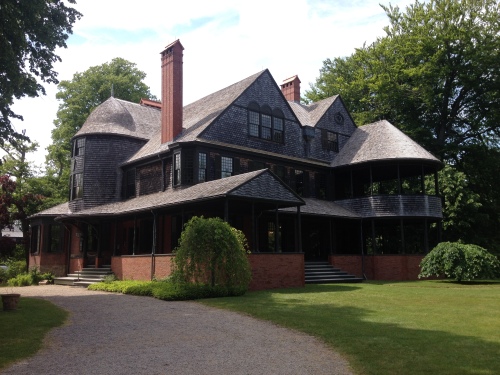
It was my favorite. It sort of reminded me of the Isaac Bell house in Newport.

There's a lot of architectural variety.

There's a lot of architectural variety.

The inside of this one is an art shop. Most of the houses were restored and were given new uses. Others were still houses rented out by the hotel.

The inside of this one is an art shop. Most of the houses were restored and were given new uses. Others were still houses rented out by the hotel.

Loud palette.

Loud palette.

Maker's mark.

Maker's mark.

This house looks like it's never been restored.

This house looks like it's never been restored.

It looks like it could use some stabilization.

It looks like it could use some stabilization.

Ruins of long-gone house.

Ruins of a long-gone house.

The du Bignon Cottage is the oldest one.

The du Bignon Cottage is the oldest one, from 1884.

August 28, 2009

Nantucket Wrap Up

I’ve been home from Nantucket for almost a month, so I’ve had time to digest everything. I thoroughly enjoyed Preservation Institute: Nantucket, from the location to the lecturers to the activities to (most) of my fellow students. I can’t imagine a better place in the U.S. to spend the summer.

On that note, I’d like to go negative. There are hundreds of things I could list about what I like about Nantucket, but here are 10 that I didn’t.

10. Bad food: I’m sure there’s great places to eat on Nantucket that aren’t too overpriced (everything is too much), and I went to at least three (Something Natural, Lola Burger, and Cy’s) but many I ate at were just awful, especially when considering the price (Fresh, Provisions, and Captain Tobey’s, I’m looking at you). Others were just mediocre (Rose & Crown and the Jetties Beach restaurant).

9. Trees on sidewalks: I’m a big fan of trees, but when they get too big and their roots start tearing up sidewalks and roads they need to go. Some of the trees along the streets in Nantucket town are hazards and it’s easy for people to get seriously hurt. However, there’s tree conservation groups on the island that protect them. As G.O.B. on “Arrested Development” would say, “Come on!” Nantucket being a windswept island didn’t even have many trees until the past century, so it’s not like the trees are part of the town’s historic appearance.

8. Cobblestones on Main Street: Unlike the trees, they are historically accurate when it comes to Nantucket’s whaling heyday. But does about a half-mile of Main Street really need to be cobblestone? Spend five minutes along the street and you’ll see what a hazard they are. Vehicles hop up and down, cyclists fall off their bikes, and scooters struggle along. The cobblestones should be kept to sparsely traveled side streets, not Main Street. Public safety beats history in this case.

7. Too many cars: This has been an ongoing problem for Nantucket, and it only gets worse. Because they were designed well before automobiles, Nantucket’s oldest, winding streets aren’t very wide and often don’t provide enough room for two cars to pass at normal speed. Plus, the island has no stoplights, making for backups at key intersections. Raising the price of bringing vehicles over on the ferry won’t help because money is no object for many residents, particularly the summer people.

6. Power lines: There are countless scenic sights in Nantucket – and plenty of power lines to block the view. I don’t know the logistics of burying lines, but you would think it would be a priority in such a windy, storm-battered island. It’s not like most of the residents couldn’t afford a tax increase to pay for it.

5. Too many cash-only places: It’s 2009 — buy a credit card machine! I had to haul a few pounds of change back in my suitcase because many establishments on the island don’t take plastic and I don’t like to carry around change, or cash for that matter.

4. Deer ticks: This is a huge problem on the island and keeps people from experiencing the many natural areas on the island. A deer tick bite can cause Lyme disease, a serious neurological disorder. Here’s hoping a rich summer resident contracts Lyme disease and pours a lot of money into research to find a cure to eradicate these ticks.

3. Some bike paths: Some bike paths I traveled were excellent (Polpis Road, Milestone, Madaket Road), but others were more dangerous than traveling on the road (Vesper Lane and Sparks Avenue). They’re narrow and set right along the road. If you’re passing someone and they aren’t paying attention, you could easily be forced off the curb and into traffic. It happened to me.

2. Lack of street signs: With Nantucket’s haphazard street layout, you would think having street signs would be a given. Not so. The ones they do have, which are gray and white, aren’t obstrustive and blend in well so ruining aesthetics can’t be a concern. It’s a very annoying island quirk that causes a lot of unnecessary frustration and wastes a lot of time.

1. Shrinking middle class: First, I don’t like this for selfish reasons: unless I marry rich, win the lottery, or write a best-seller, I’ll never be able to afford housing on Nantucket. The gap between the rich and the working class on the island is vast and only growing. For years summer workers have commuted from Cape Cod via ferry or plane, and as long as there’s a demand this will continue. (When it’s cheaper to live on the Cape and commute 25 miles across Nantucket Sound every day, you know you have a dearth of affordable housing.) The problem is the declining number of middle class year round residents. Many of them only are still able to live on the island because they inherited their property, and unless their children follow the same path they will be forced to seek a life in “America.” Much of what people cherish about Nantucket are traditions begun and kept alive by the middle class. What happens when no teachers, firefighters, and store managers can live there? The island needs subsidized housing. I know of at least one instance of this on the island (an old school converted into apartments). Nantucket can feel like a gated community it’s so far from other land. If it keeps losing its middle class residents, it will actually be one.

Honorable mention: the lack of bike racks in downtown; too many bugs; the Civil War monument intersection and its shortage of signage directing people what to do (is it a roundabout or just something in the middle of the road?); and the lack of visible signs denoting historic houses (the small, copper plaques don’t work; the Nantucket Preservation Trust’s fan signs are better but don’t reveal much).

The Maria Mitchell House, now owned by the Maria Mitchell Association and where we did our group documentation project. It was built in 1790 and is the birthplace of Maria Mitchell, the first woman to discover a comet.

The Mitchell House, now owned by the Maria Mitchell Association and where we did our group documentation project. It was built in 1790 and is the birthplace of Maria Mitchell, the first woman to discover a comet.

The Boston-Higginbotham House, where I did an independent study interior easement project with a partner. It was built circa 1774 and was owned by two separate black families for more than 200 years.

The Boston-Higginbotham House, where I did an interior easement project. It was built circa 1774 and was owned by two different black families for more than 200 years.

Group shot from one of our first days on the island.

Group shot from one of our first days on the island in June, hence the clothing.

August 20, 2009

Siasconset Part 3

Here are more photos I took on my three visits to Sconset, a village on the easternmost shore of Nantucket and not a place I would want to be this weekend as Hurricane Bill spins past.

IM000906

IM000040

IM000486

IM000428

IM000903

IM000477

IM000041

IM000418

IM000463

IM000902

 IM000485

August 3, 2009

Nantucket Part 9

I forgot to add last time that I attended my first historic district commission meeting July 21 in Nantucket. Because the Nantucket Historic District encompasses the entire island, every single change must go before the board. So unlike most commissions that met once a month or biweekly, the Nantucket Historic District Commission meets every Tuesday evening. The meeting I attended lasted about two hours and 25 projects were introduced, but I would imagine that’s considered light.

The meeting wasn’t the most fun I’ve ever had, but it was interesting. Most of the projects were tabled so the commissioners could go view the proposed changes. Revisions were requested on many others. A few were OK’d. In other words, for a homeowner to change anything on the island, no matter how small, is a very tedious process; the Nantucket Historic District Commission has a lot of control over how the place looks.

With that said I don’t think everyone on the board was in the same league when it came knowledge about architecture and construction. I don’t want to pass judgment because I only attended one meeting, but it wouldn’t be too far fetched to say the building industry has insiders on the board.

Last week, my final on Nantucket, began with a presentation by Arlene Fleming, who used to work for the World Bank and is now an intangible history consultant. She spoke about the lack of importance placed on intangible aspects of historic preservation, for example timber framing, blacksmithing, and plastering. I feel teaching people how to  do a particular traditional trade can be just as important as saving a (tangible) building.

I spent the remainder of the week completing both our documentation project at the Maria Mitchell House (along with seven other team members) and my independent study project at the Boston-Higginbotham House (along with one other partner).

For the Mitchell House project, we had to finish measuring both the interior and exterior, convert the drawings to CAD, and write a conditions report. On Friday morning, members of the community were invited to hear what we did all summer at the house. I was in charge of describing what we did during the paint analysis.

For the Boston-Higginbotham House project, we went room by room and chronicled the architectural features we believed should be included in the interior easement and what era each originated from. The house was thoroughly photographed, and then we put together a Power Point presentation. On Friday we presented our work to our classmates and a few guests, including Renee and Bill Oliver, caretakers of the Boston-Higginbotham House and the neighboring African Meeting House.

Program director Marty Hylton hosted a going-away dinner Friday evening (my third lobster dinner in five days), and I left ACK on Saturday morning. My summer on Nantucket is over.

I have a few more entries left; here are some more random photos.

Residences along a wharf.

Residences along a wharf.

IM000252

Civil War monument

Civil War monument

The Oldest House was built in 1686. But it was blown apart by lightning in 1987 and rebuilt, so I don't think it's very authentic.

The Oldest House was built in 1686. But it was blown apart by lightning in 1987 and rebuilt, so I don't think it's very authentic.

IM000027